The Problem With Training on the Real Thing
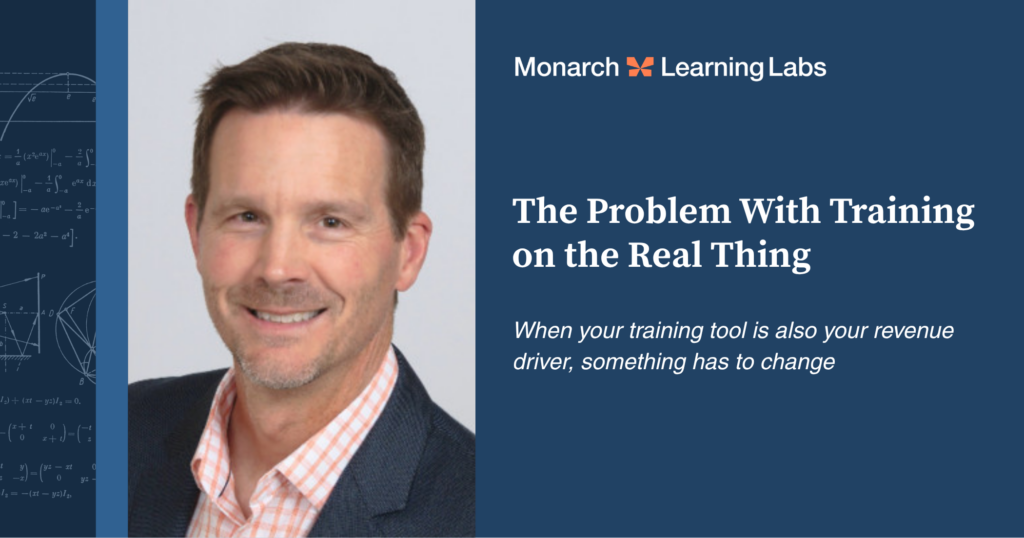
My career has taken more turns than most. Engineer, MBA, product development, product management, marketing, sales, international business development, cybersecurity. I even owned my own company for a stretch. At some point, you stop calling it a winding path and start calling it a toolkit.
That toolkit is what brought me to Monarch, where I serve as Chief Operating Officer. But the story of how I got here really starts about five years ago, with a client, a robot, and a training problem that didn’t have a good solution.
The Robot That Couldn’t Leave the Room
One of our clients makes a sophisticated surgical device, an instrument that assists surgeons during a specific procedure. It helps guide them. It surfaces useful information in real time. It improves patient outcomes.
Think of it like an airplane. An airline makes money when a plane is in the air and full of passengers. This device is the same. You make money when it’s in the operating room, doing surgery.
That framing made the training problem obvious. Surgeons needed to learn the system. Existing surgeons needed to keep their skills current. New staff needed to get up to speed. Seminars needed a way to walk a room full of people through the same procedure simultaneously. All of that training, under the traditional model, required the physical device.
And every hour the device was being used for training was an hour it wasn’t generating revenue.
On top of that, there aren’t many of these devices. So training wasn’t just expensive in terms of equipment time. It required travel. Fly people in. Schedule around the device. Try to compress meaningful learning into a window that doesn’t disrupt the clinical calendar. It worked. But it didn’t scale.
Building Something That Behaves Like the Real Thing
What we built was a digital twin of the device. And I want to be precise about what that means, because “simulation” can suggest something basic. This wasn’t a mockup. It wasn’t a rough approximation you could generate with a prompt.
The device is complex. Surgeons give it inputs and it produces outputs, and during surgery those outputs have to be exactly right. Our digital twin had to match that behavior completely, including the underlying calculations and 3D mechanics that drive it. If it didn’t behave like the real device, it wouldn’t train people to use the real device.
That’s the hard part, and it’s where most of the work lived.
Once we had the twin, we wrapped it inside a learning management system. Surgeons can now access training anywhere there’s an internet connection. Administrators can assign specific activities and sequence them into full programs. Users move through instructional content and then into the simulation, where they complete defined tasks and build real proficiency. No travel required. No equipment time consumed.
The client uses it to onboard new surgeons, refresh experienced ones, and run seminars where every participant works through the same procedure simultaneously. Training that was once logistically prohibitive is now accessible and repeatable.
Efficiency at Every Layer
From an operations perspective, the value of this model is in how it’s built on our end.
If it took Monarch as much time and resources to spin up a new client as it would cost that client to keep running traditional training, the math wouldn’t work. So we’ve invested heavily in the platform itself, making it faster to build a new digital twin, faster to configure activities, and easier to manage for administrators and users alike.
The goal is to come in at a meaningfully lower price point than whatever a client is currently spending on training. That’s what makes this a compelling alternative rather than just an interesting one.
And to be clear about what this is and isn’t: we’re not trying to replace in-person training. In surgery, nothing replaces the training surgeons do with each other in the operating room. What we’re replacing is the inefficient, expensive process of getting someone to that point. We bring people to a solid foundation. They refine it in the real environment. That division of labor is where the efficiency lives.
Where AI Fits In
We started this project five years ago. If you had to name the single biggest shift in technology since then, the answer is obvious: AI.
So the question we kept asking ourselves was how to use it meaningfully, not just as a talking point, but in ways that actually improve the training experience.
We’ve built it in at two levels.
The first is evaluation. When we ask a user a question, we don’t just record their answer. We first set up the question for the model, providing background on the device and a rubric for assessing the response. The user answers. We send their response, along with that context, to the model. It comes back with something close to what a skilled instructor would say: here’s what you got right, here’s what you missed, here’s where to go back and review. All automated. All available on the user’s own time.
The second is a reference. Many of these devices come with detailed instruction manuals. We ingest the full manual into the model so it understands the device. We can then ask it to automatically generate training activities. And we’re building toward something further: a live assistant inside the simulation itself, where a user can ask a question mid-training and get guidance drawn directly from the source documentation.
The through line is the same. Take what already exists, the expertise, the content, the institutional knowledge, and use modern tools to make it more accessible, more scalable, and more useful.
What This Opens Up
The healthcare use case is where we started, but the underlying problem isn’t unique to healthcare. Any industry with complex equipment, distributed teams, and high stakes for getting training right faces a version of this same challenge. Manufacturing. Energy. Transportation. The model travels.
What Monarch has built is a platform for closing the gap between how technology works and how well people are prepared to use it. That’s a problem worth solving. And five years of building toward it has convinced me we’re doing it the right way.
Jim Lutz is the Chief Operating Officer of Monarch Learning Labs.