The Business Case Is the Story
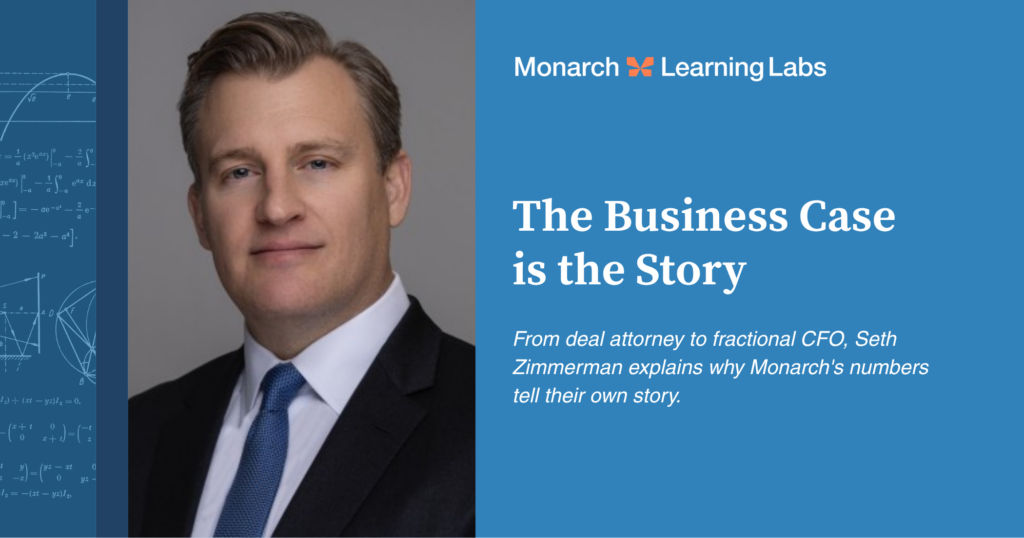
I started my career as a deal attorney. M&A, private equity, venture capital. But I kept finding myself more interested in the companies than the transactions. If you want to be good at deal work, you have to love the deal. I loved the companies.
So I made a shift. I moved into technology, leaned into finance, earned an MBA from Carnegie Mellon, and over time built a career as a financial operator. Today, I serve as a fractional CFO across several companies, sit on the investment committee of LifeX Ventures here in Pittsburgh, and get embedded in portfolio companies for a private equity group out of Indiana.
I describe my background as a Swiss Army knife: part finance, part legal, part operator. It’s an unusual combination. But in the right situation, it can be exactly what’s needed.
Why Monarch
I’ve known Jeremy for a couple of years through the Pittsburgh ecosystem. We started working together at his previous company, and when that chapter ended and he launched this venture, the conversation continued naturally.
He asked if I had time. I said yes.
But that undersells it. I said yes because I genuinely liked what I saw.
The technology is on the leading edge. Digital twin is a known market segment, but it’s still taking shape in real time. Being early in a fast-growing space is an enviable position for any company to be in. The team is strong. Jeremy, Alison, and the broader group are competent, thoughtful, and easy to work alongside.
And the two markets Monarch is focused on, healthcare and workforce development, are both areas where the need for better solutions is hard to overstate.
Healthcare is wildly expensive and, relative to that cost, not producing the best outcomes. Anything that adds efficiency to that system without sacrificing quality is worth attention. There’s also real money in healthcare, which matters: you can do good and do well at the same time. That’s not always true.
Workforce development resonates with me more personally. I grew up in central Pennsylvania, the kind of old manufacturing town that shaped a certain work ethic and a certain set of challenges. There are a lot of good people ready and willing to learn new skills. They just need the right tools and the right access. Monarch is building toward that.
The CFO View
If I’m being honest, my most useful contribution here isn’t strategy or storytelling. It’s the financial lens.
And from that seat, the business model is genuinely compelling.
When you replace a non-digital asset with a digital one, when a company no longer needs to fly trainers across the country, ship equipment to multiple sites, or compress critical learning into a single high-pressure session, the cost savings are immediate and obvious. The ROI case doesn’t require a complicated spreadsheet.
Internally, digital-first delivery sets a company up to be lean. Margins can be high. The economics scale in a way that in-person, travel-heavy models simply don’t.
But there’s something else worth naming. A global healthcare company is already using this technology. That’s not a trivial proof point. Organizations like that don’t spend money on unproven tools. That validation matters.
And the AI piece matters too. Everyone in every boardroom I’ve been in for the past two years has had some version of the same conversation: We know we need to use AI. How do we actually use it? The challenge isn’t awareness. It’s application. Monarch’s approach to incorporating AI into more advanced features isn’t aspirational. It’s thoughtful and practical. That’s rarer than it sounds.
The opportunity has legs. The team is strong. The business model works.
For me, that’s the story worth telling.
Seth Zimmerman is a fractional CFO and financial advisor to Monarch Learning Labs. He is based in Pittsburgh and serves on the investment committee of LifeX Ventures.